Learn Analog Circuits with Zundamon

Episode 2

Channel-Length Modulation, Output Resistance and Body Effect

Why does a MOSFET's current keep increasing in saturation? Explore channel-length modulation, output resistance, and the body effect.

Watch on YouTube (6:44)
  • Shikoku Metan (explains)
  • Zundamon (asks)

1Intro: a lab graph that slopes upward

Zundamon

Metan, my lab report is in trouble! The current increased even in saturation!
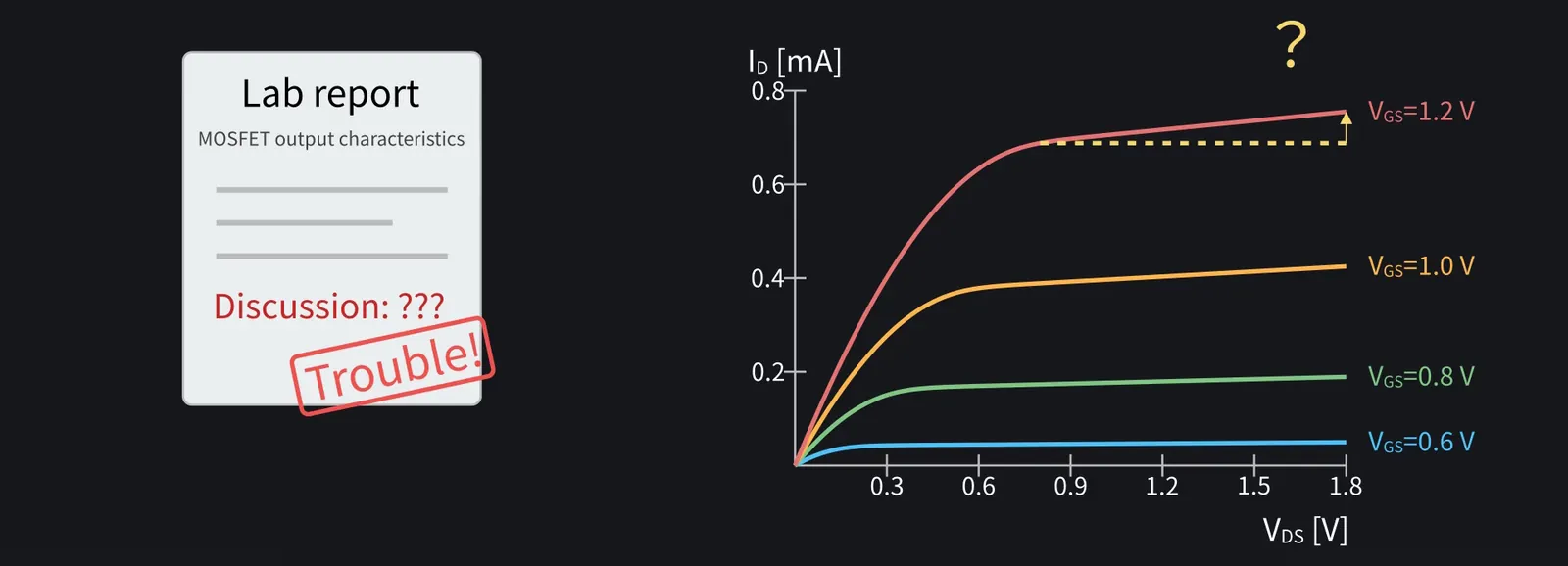
Illustration: Metan, my lab report is in trouble! The current increased even in saturation!
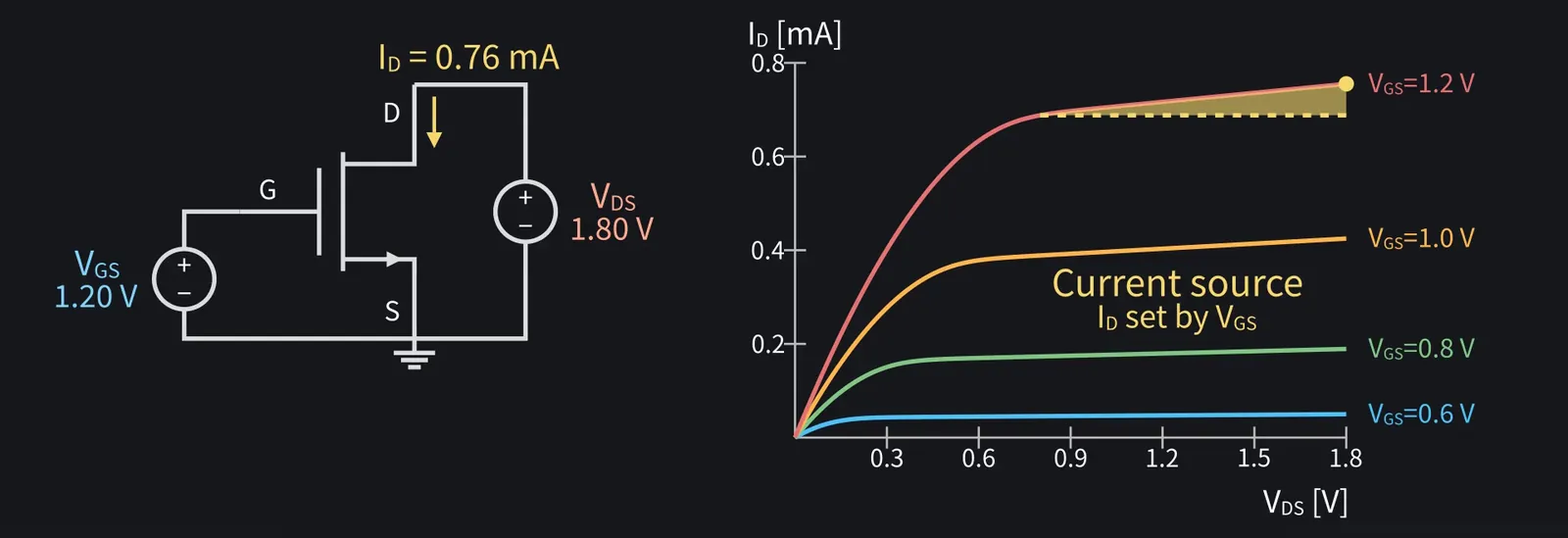
Figure 1

Shikoku Metan

Let's review. In saturation, a MOSFET is a current source controlled by VGS.

Shikoku Metan: Last time, the saturation curves sloped upward slightly as VDS increased.

Illustration: Last time, the saturation curves sloped upward slightly as VDS increased.
Figure 2

Shikoku Metan

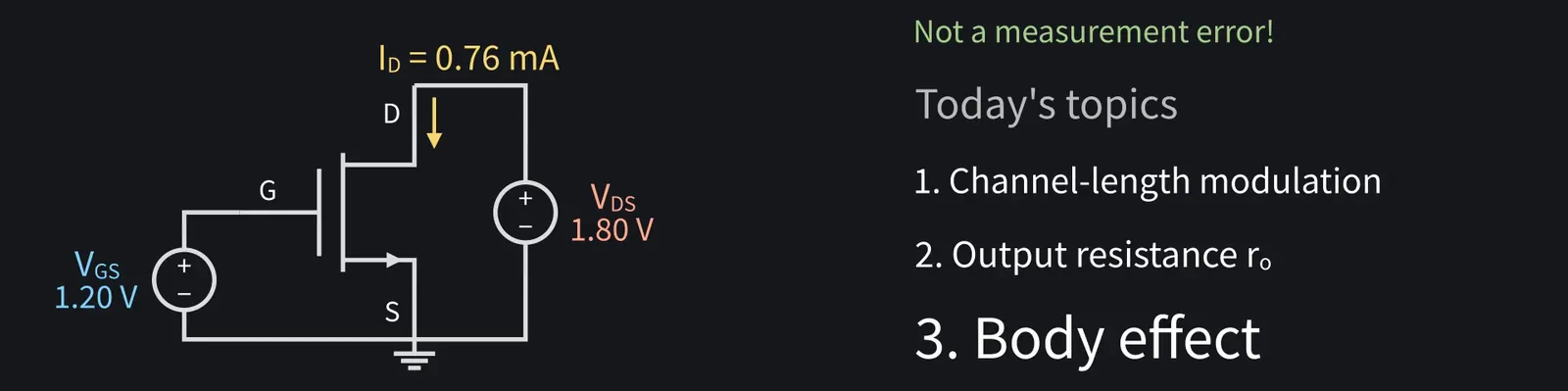
That isn't a measurement error. Let's explore that slope, the output resistance ro, and the body effect.

Illustration: That isn't a measurement error. Let's explore that slope, the output resistance ro, and the body effect.
Figure 3

Zundamon

Please! I want to explain the results in my report, nanoda!
Shikoku Metan

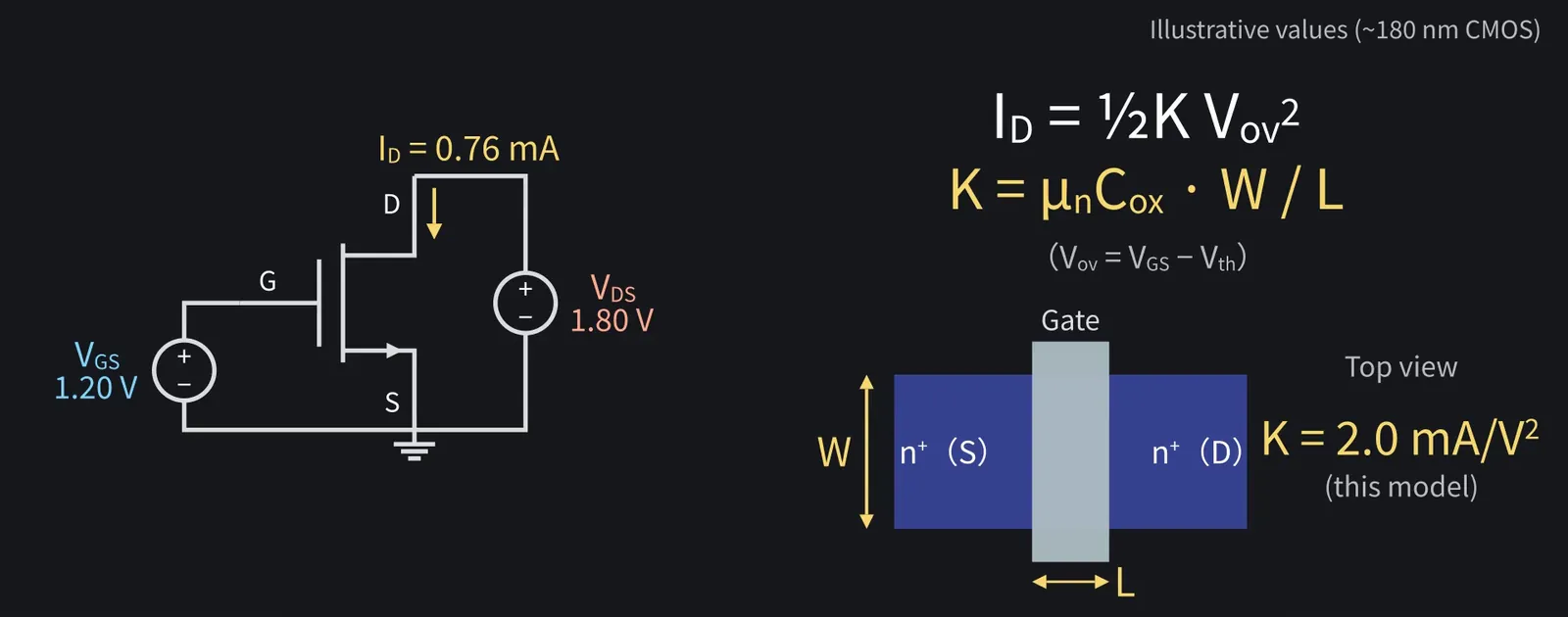
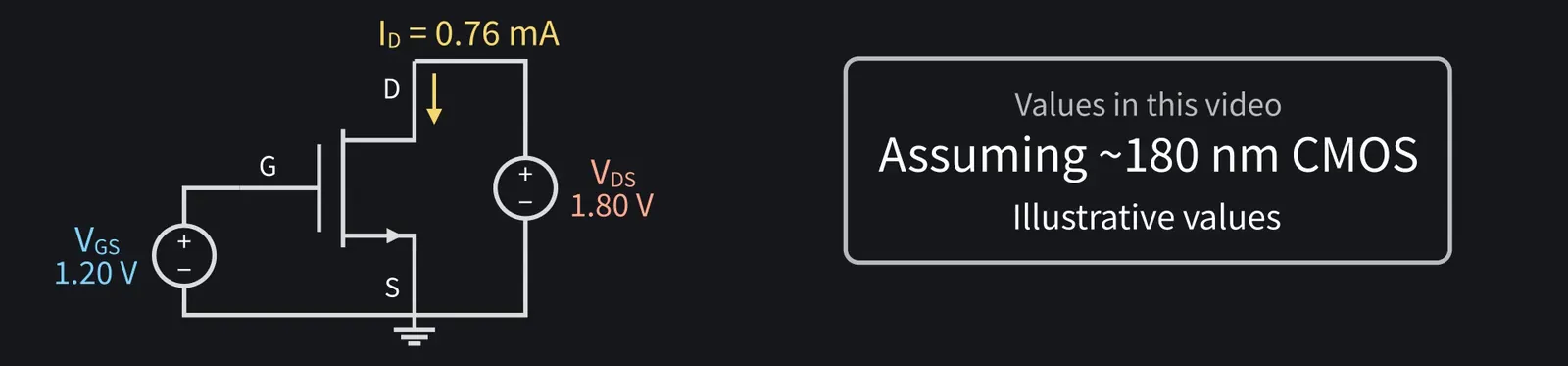
The numbers are illustrative values, assuming roughly a 180 nm CMOS process.

Illustration: The numbers are illustrative values, assuming roughly a 180 nm CMOS process.
Figure 4

Shikoku Metan

Last time's square law was ID = ½K·Vov², with Vov=VGS−Vth and K standing for μnCox·W/L.

Shikoku Metan: W is the channel width and L its length. This model uses K = 2 mA/V² and Vth=0.4 V.

Illustration: W is the channel width and L its length. This model uses K = 2 mA/V² and Vth = 0.4 V.
Figure 5

2Measuring the slope

Shikoku Metan

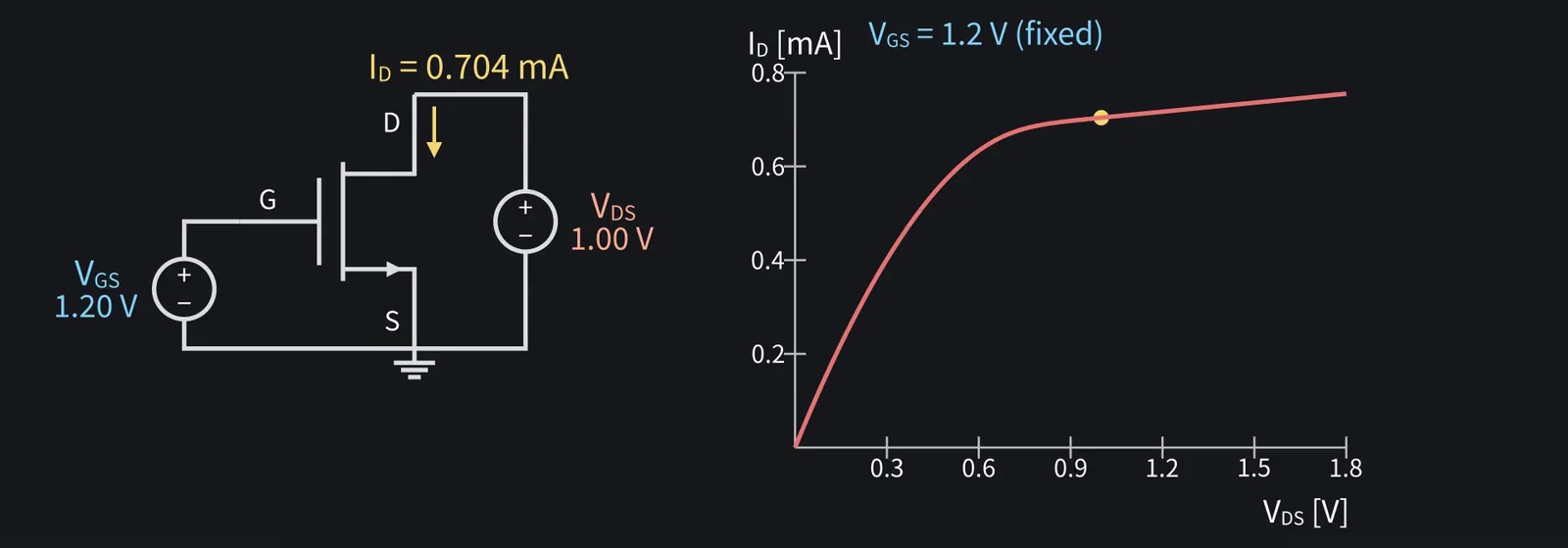
Hold VGS at 1.2 V and raise VDS from 1.0 V to 1.5 V.

Illustration: Hold VGS at 1.2 V and raise VDS from 1.0 V to 1.5 V.
Figure 6

Zundamon

ID rose from 0.704 mA to 0.736 mA. Just a little!
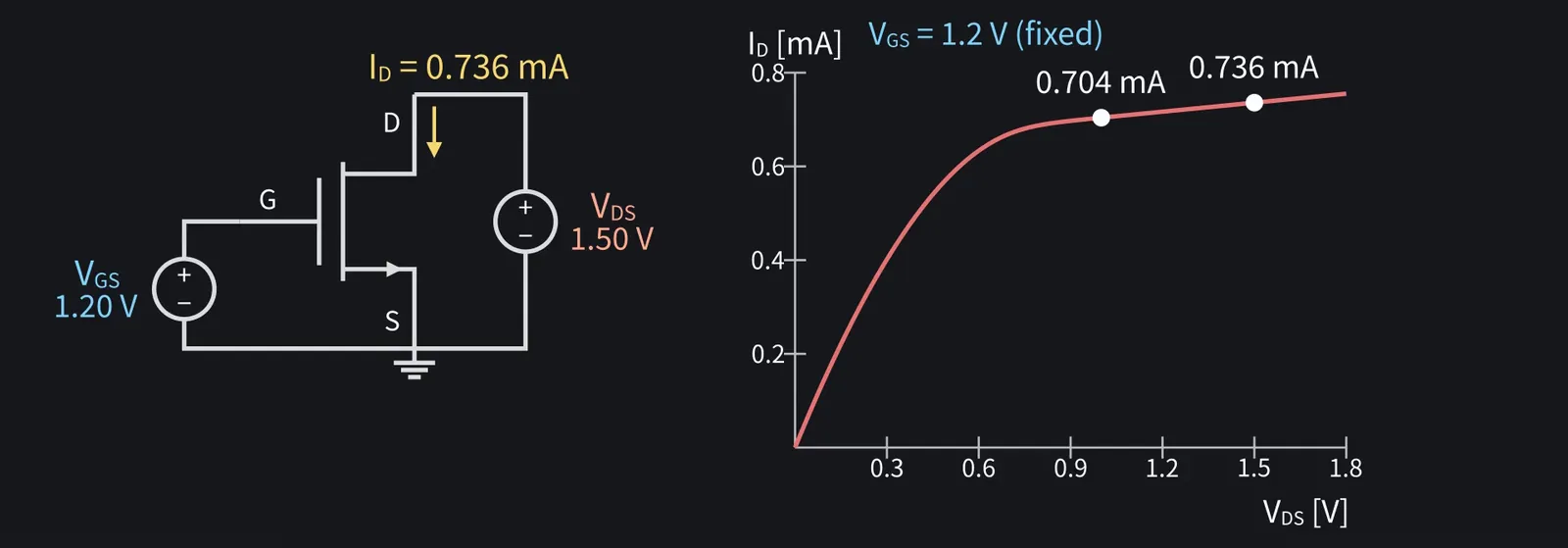
Illustration: ID rose from 0.704 mA to 0.736 mA. Just a little!
Figure 7

Shikoku Metan

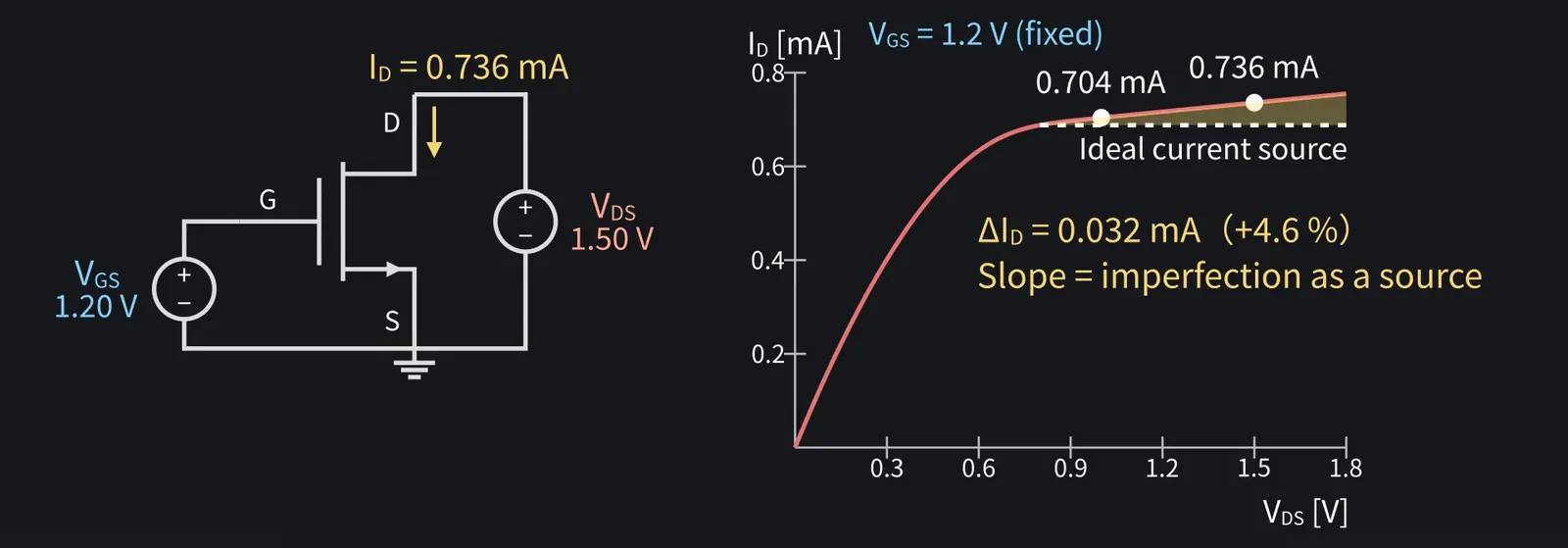
Less than five percent, but that difference matters in an amplifier.

Zundamon

An ideal current source wouldn't change its current when VDS changes.
Shikoku Metan

Right. This slope measures how imperfect it is as a current source.

Illustration: Right. This slope measures how imperfect it is as a current source.
Figure 8

3The cause: the pinch-off point moves

ZundamonQuestion

But I thought the saturation curve was flat. Why does it slope?
Shikoku Metan

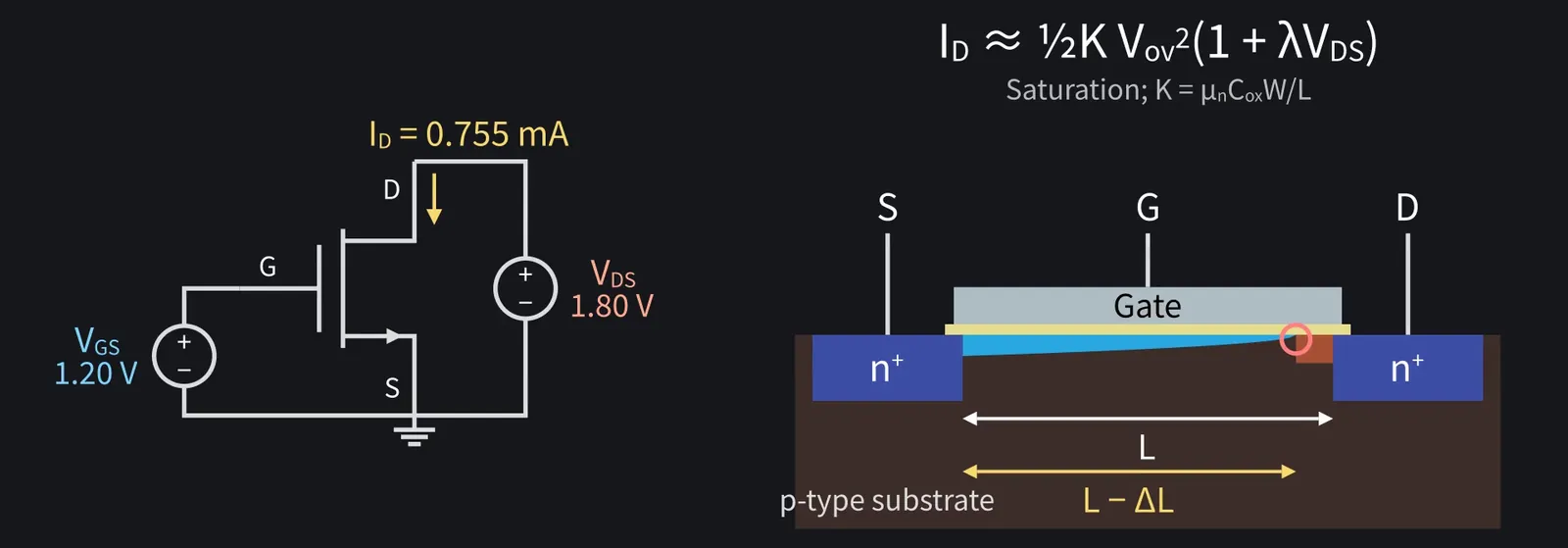
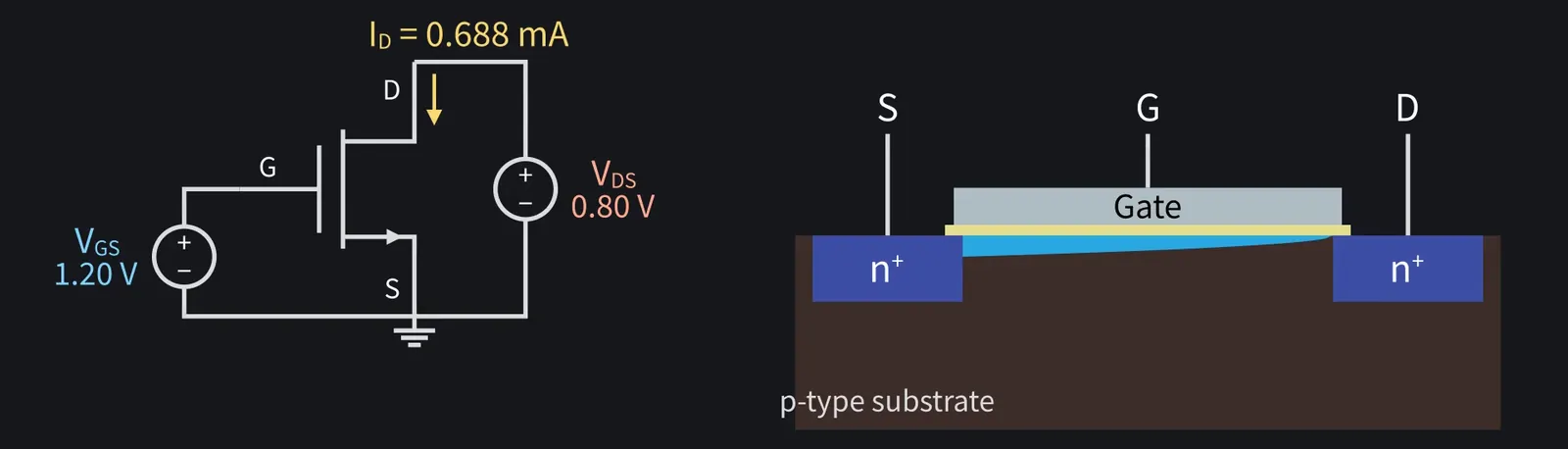
Back to the cross-section. In saturation, the channel ends near the drain.

Illustration: Back to the cross-section. In saturation, the channel ends near the drain.
Figure 9

Shikoku Metan

The voltage at the pinch-off point stays at about Vov above the source.

Shikoku Metan: The rest of VDS appears across the gap between pinch-off and the drain.

Shikoku Metan: Raising VDS widens that gap, moving pinch-off toward the source.

ZundamonQuestion

So the channel gets shorter?

Shikoku Metan

Yes, its effective length decreases slightly. That's channel-length modulation.

ZundamonQuestion

Why does a shorter channel mean more current?

Shikoku Metan

The voltage across the channel stays at Vov, while its length gets shorter.

Shikoku Metan: ID is proportional to W/L, so reducing L increases ID.

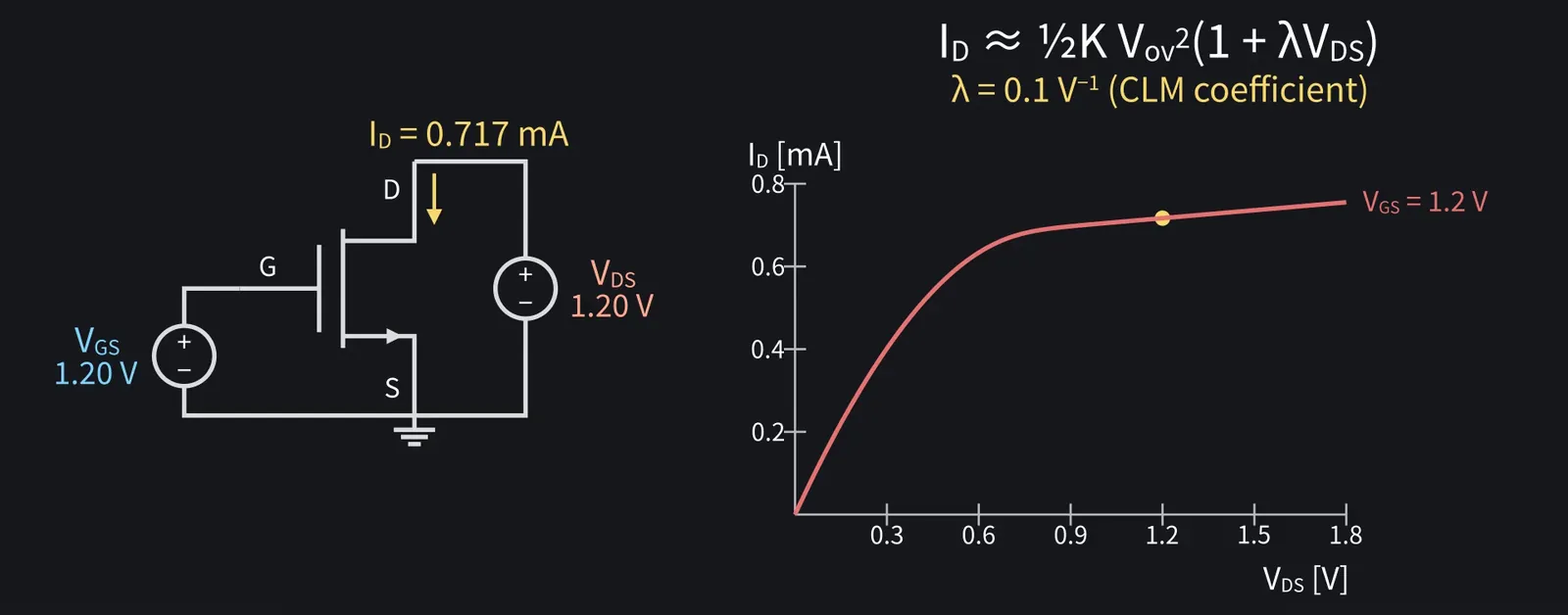
4The equation: ID ≈ ½KVov²(1 + λVDS)

Shikoku Metan

ID is proportional to 1/L, so a small fractional shrink in L raises ID by about the same fraction. For simplicity we take that fraction to be proportional to VDS, which multiplies the square law by (1 + λVDS).

Illustration: ID is proportional to 1/L, so a small fractional shrink in L raises ID by about the same fraction. For simplicity we take that fraction to be proportional to VDS, which multiplies the square law by (1 + λVDS).
Figure 10

Shikoku Metan

λ is the channel-length modulation coefficient. Here, λ = 0.1 V⁻¹.

Illustration: λ is the channel-length modulation coefficient. Here, λ = 0.1 V⁻¹.
Figure 11
Try it yourselfID–VDS characteristics: the slope in saturation

Even to the right of the boundary, ID continues to rise slightly with VDS. The reciprocal of this slope is the output resistance ro, caused by channel-length modulation.

5Output resistance ro and the equivalent circuit
Shikoku Metan

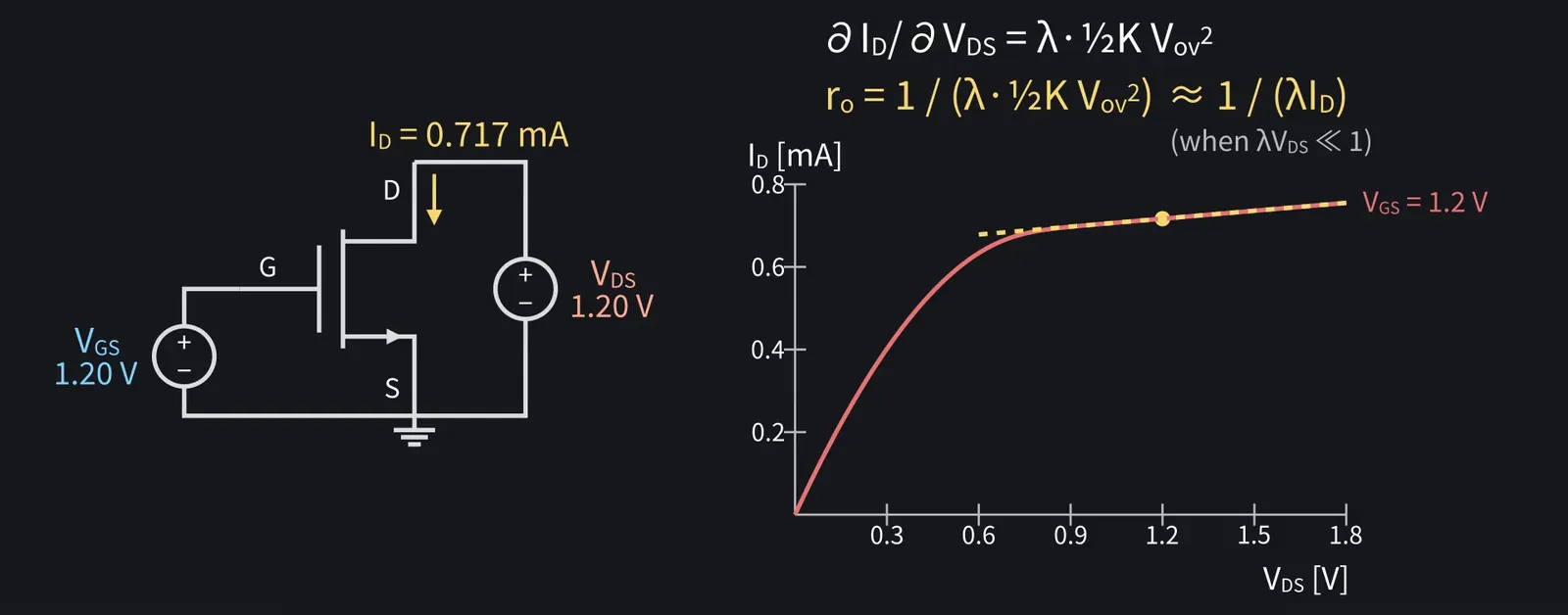
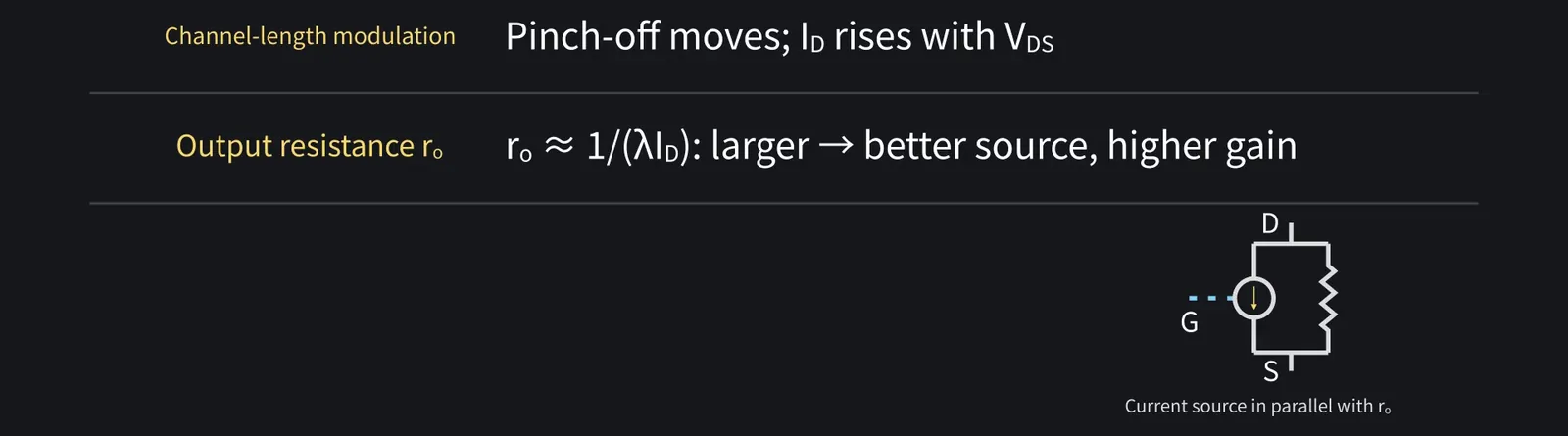
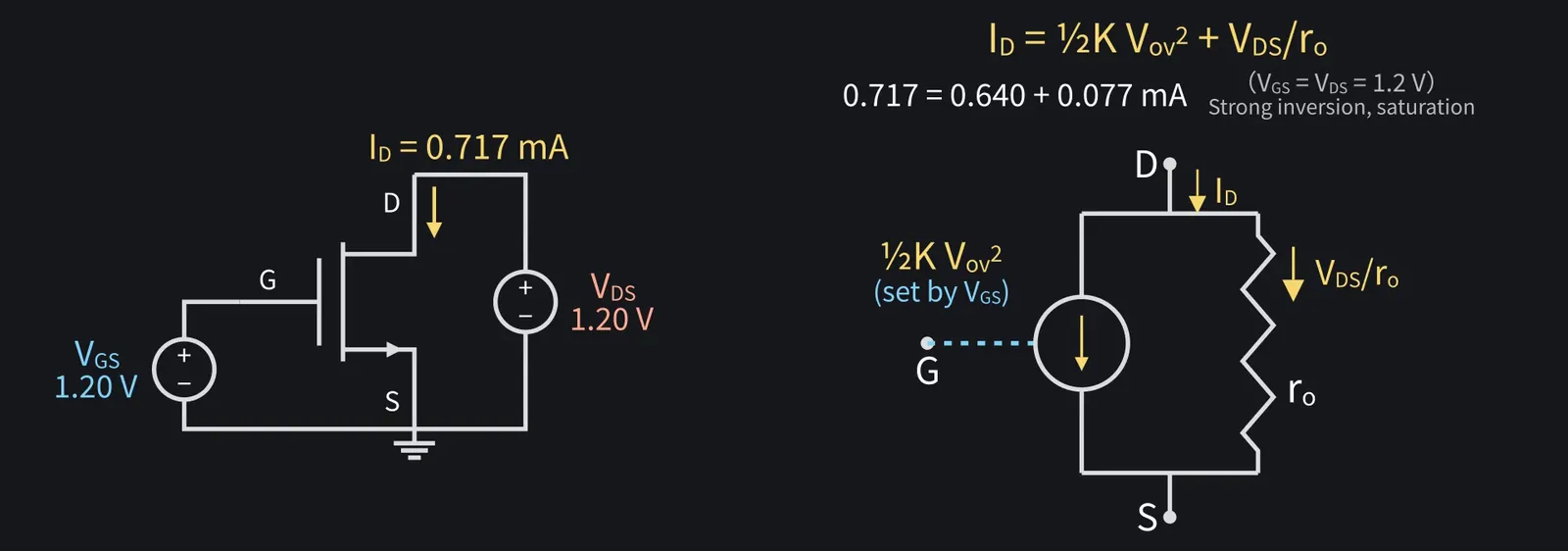
Hold VGS fixed. The reciprocal of this slope in saturation, ΔVDS divided by ΔID, is called the output resistance ro.

Shikoku Metan: Replace the saturated MOSFET with a current source in parallel with ro.

Shikoku Metan: The source gives ½KVov²; adding VDS/ro gives ID.

Illustration: The source gives ½KVov²; adding VDS/ro gives ID.
Figure 12

Zundamon

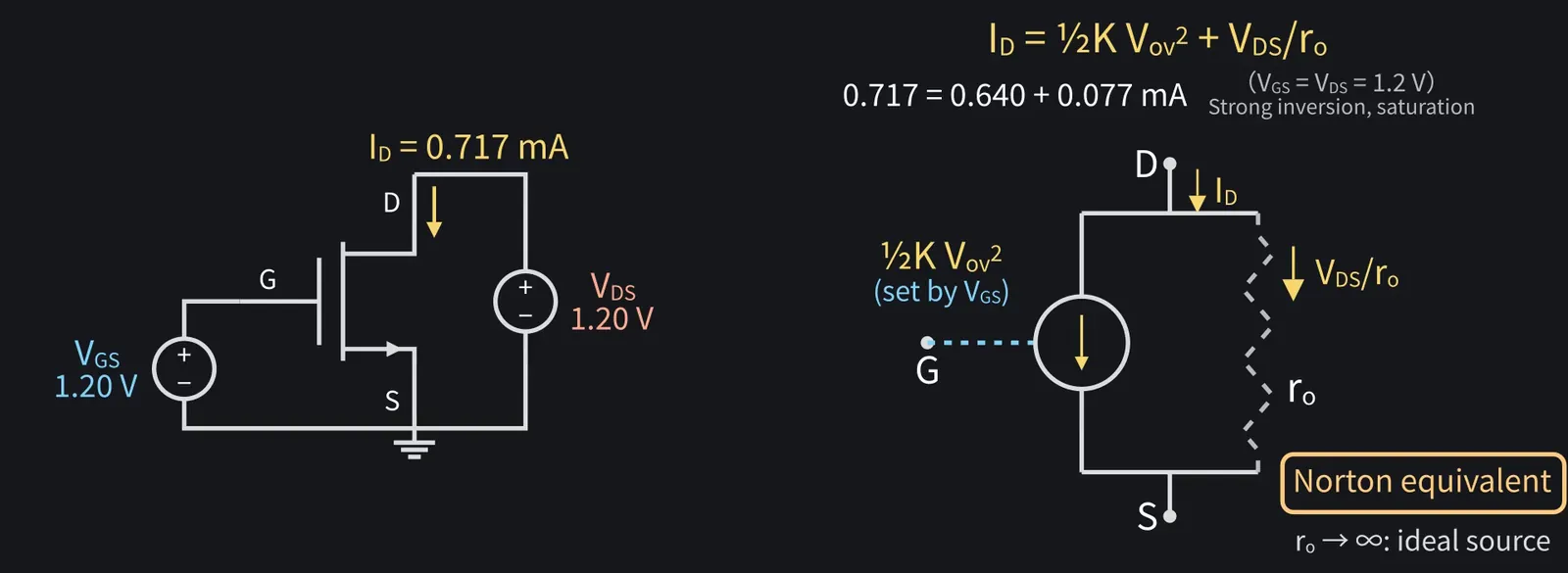
Like the Norton equivalent circuit from circuit theory!
Shikoku Metan

Exactly. Infinite ro means an ideal source. Larger ro gets closer to ideal.

Illustration: Exactly. Infinite ro means an ideal source. Larger ro gets closer to ideal.
Figure 13

Shikoku Metan

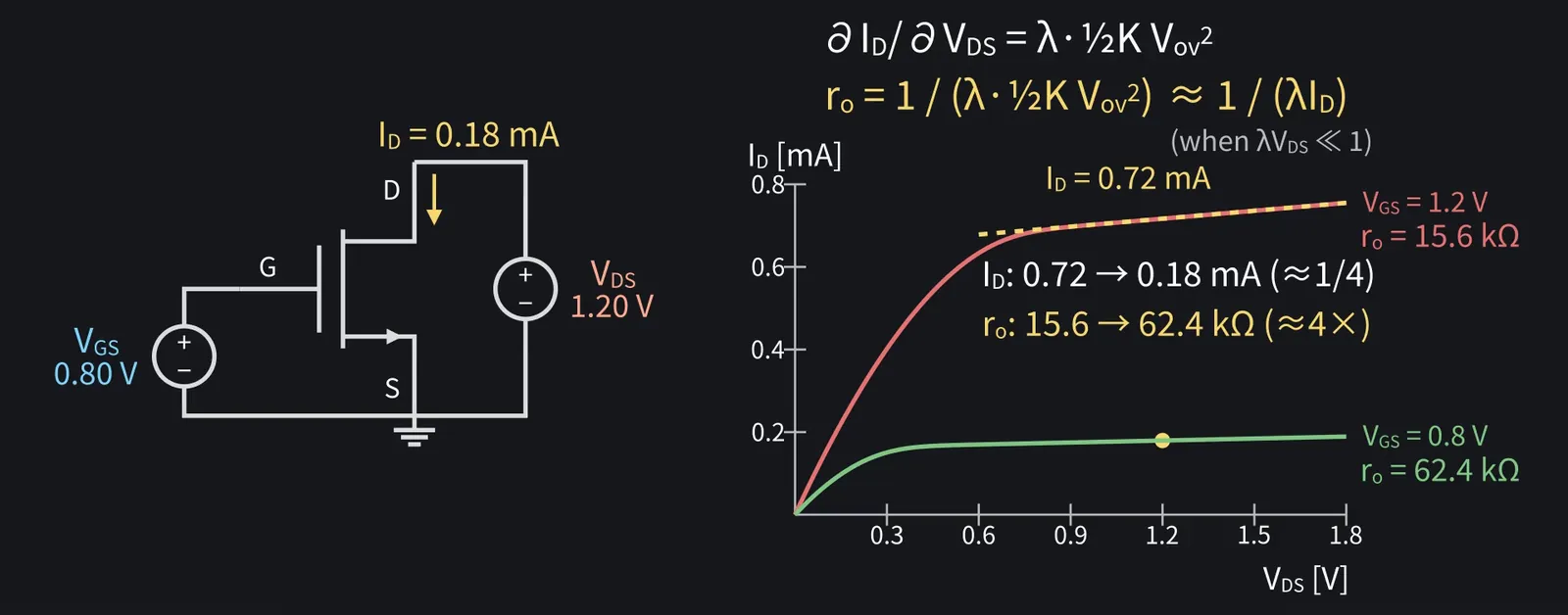
Differentiate with respect to VDS: slope = λ·½KVov². Its inverse is ro.

Shikoku Metan: If λVDS ≪ 1, ID ≈ ½KVov², so ro≈1/(λID).

Illustration: If λVDS ≪ 1, ID ≈ ½KVov², so ro ≈ 1/(λID).
Figure 14

Shikoku Metan

At VGS=1.2 V, Vov=0.8 V, so ½KVov² = 0.64 mA and ro≈1/(0.1×0.64) ≈ 16 kΩ.

Zundamon

And from the measurement, ΔVDS/ΔID=0.5 V/0.032 mA≈16 kΩ. It matches!
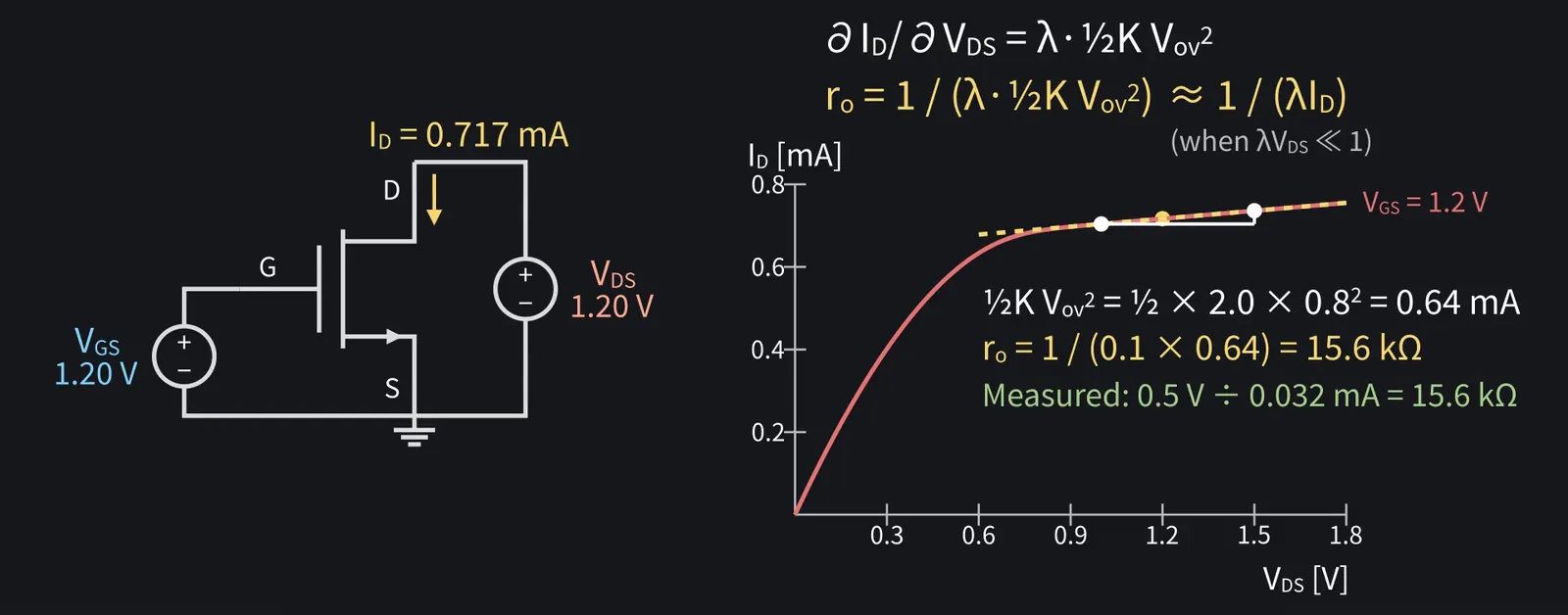
Illustration: And from the measurement, ΔVDS/ΔID = 0.5 V / 0.032 mA ≈ 16 kΩ. It matches!
Figure 15

ZundamonQuestion

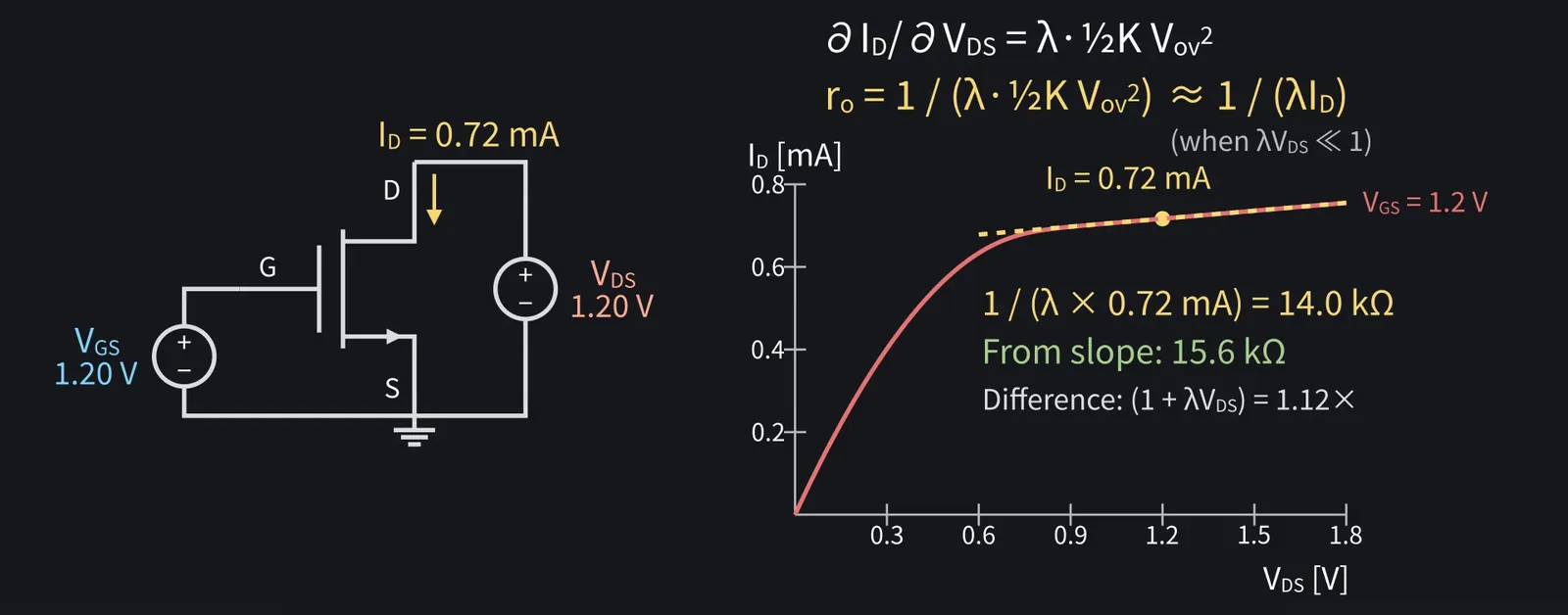
But if I plug in the actual ID of 0.72 mA, it comes out a bit different, nanoda?
Shikoku Metan

About 14 kΩ. It's off by roughly ten percent, but that's fine for hand estimates.

Illustration: About 14 kΩ. It's off by roughly ten percent, but that's fine for hand estimates.
Figure 16

ZundamonQuestion

Does ro depend on the current?
Shikoku Metan

Yes. At VGS=0.8 V, current is about a quarter, and ro is four times larger: 62 kΩ.

Illustration: Yes. At VGS = 0.8 V, current is about a quarter, and ro is four times larger: 62 kΩ.
Figure 17

Shikoku Metan

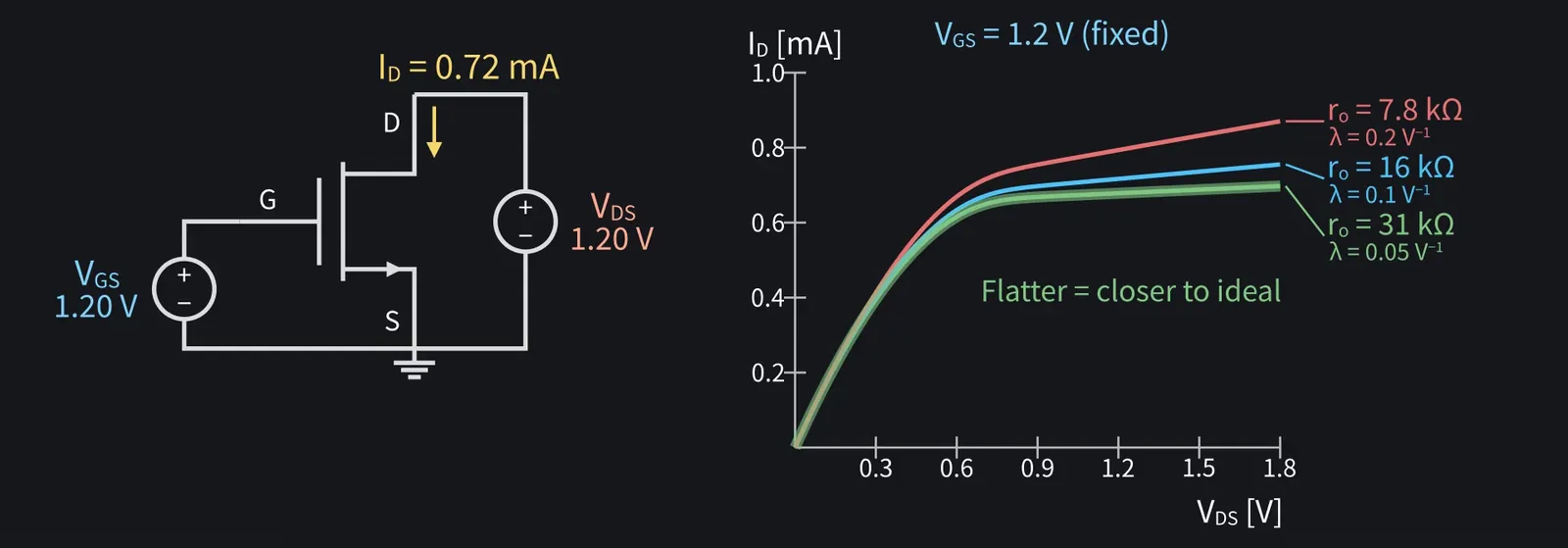
Compare different λ values. Larger ro means less slope and a flatter curve.

Illustration: Compare different λ values. Larger ro means less slope and a flatter curve.
Figure 18

Zundamon

Small ro gives a steeper upward slope!

6Early voltage VA
Shikoku Metan

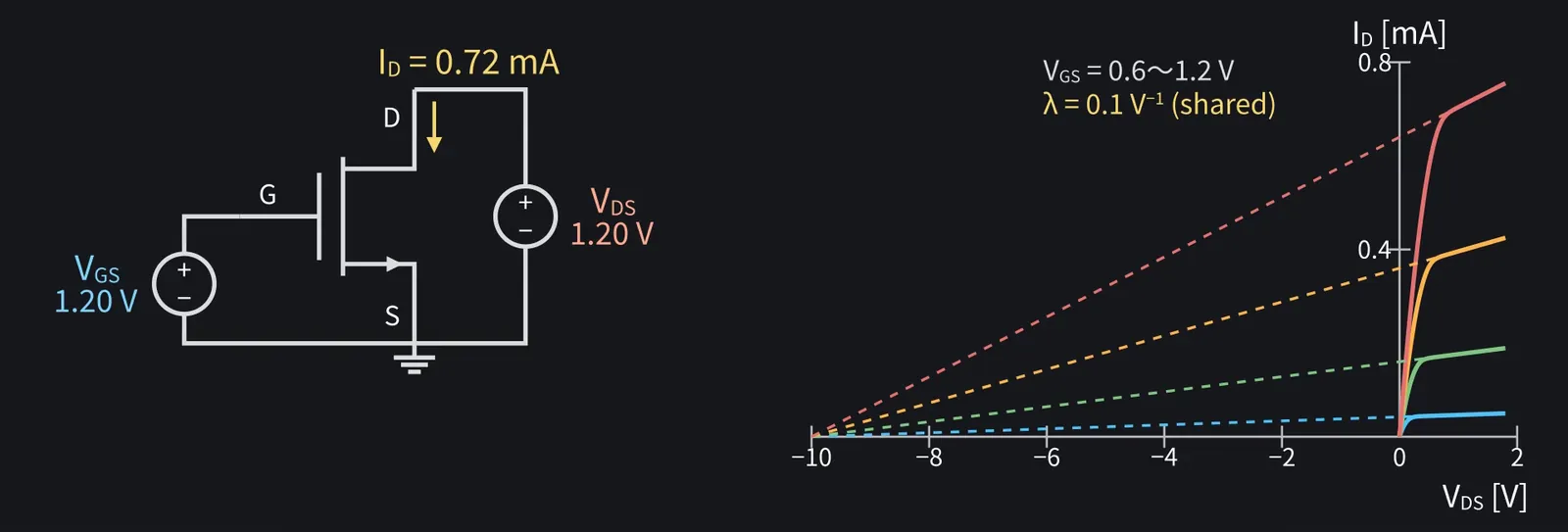
Set λ back to 0.1, and extend the straight saturation portions of the curves for different VGS toward negative VDS.

Illustration: Set λ back to 0.1, and extend the straight saturation portions of the curves for different VGS toward negative VDS.
Figure 19

Zundamon

They all meet at VDS = −10 V!
Shikoku Metan

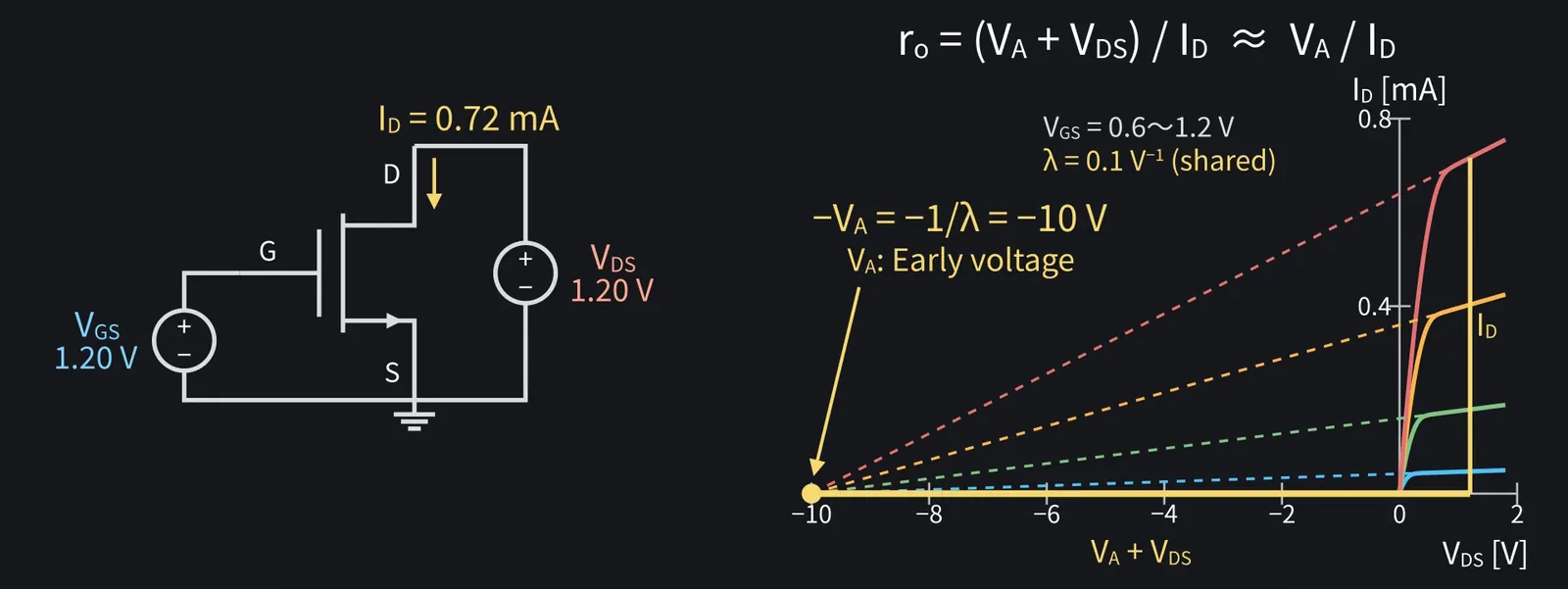
In this model they meet exactly. The magnitude of that voltage is called the Early voltage, VA=1/λ.

Shikoku Metan: Then ro≈VA/ID. A larger Early voltage means a better current source.

Illustration: Then ro ≈ VA/ID. A larger Early voltage means a better current source.
Figure 20

7Channel length L and λ

ZundamonQuestion

How can we make ro larger?
Shikoku Metan

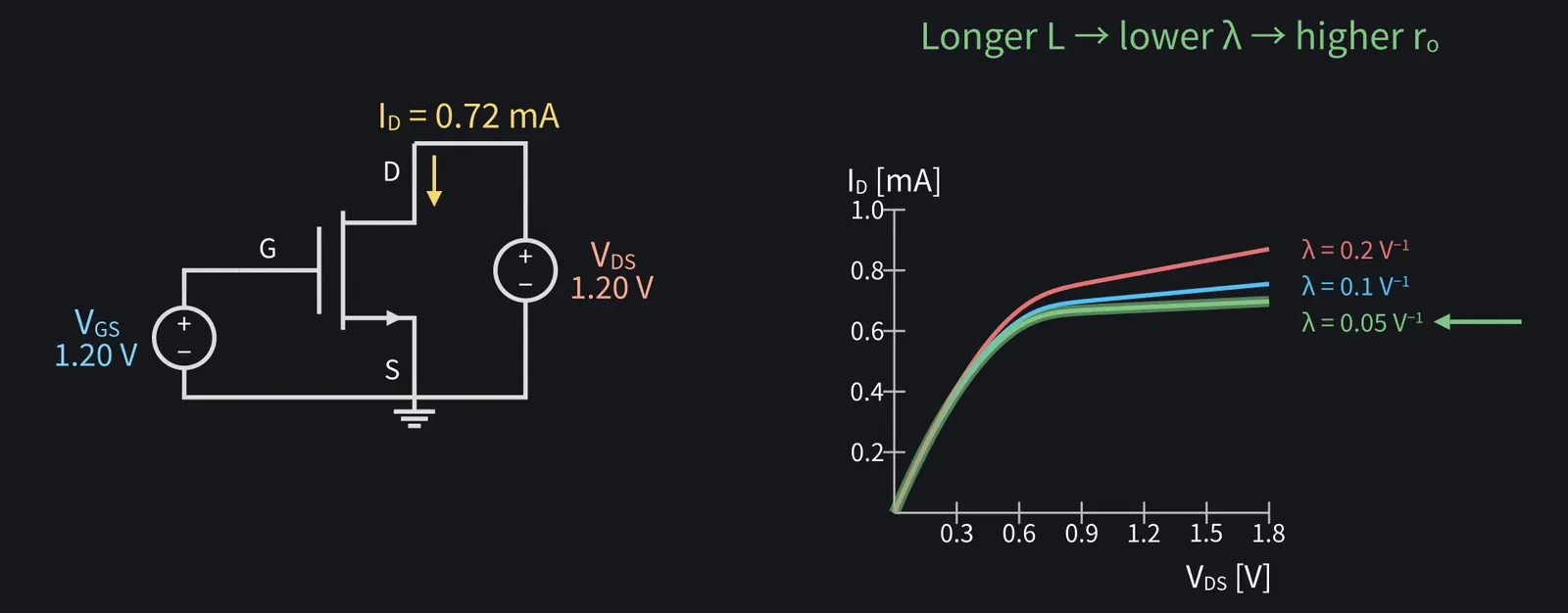
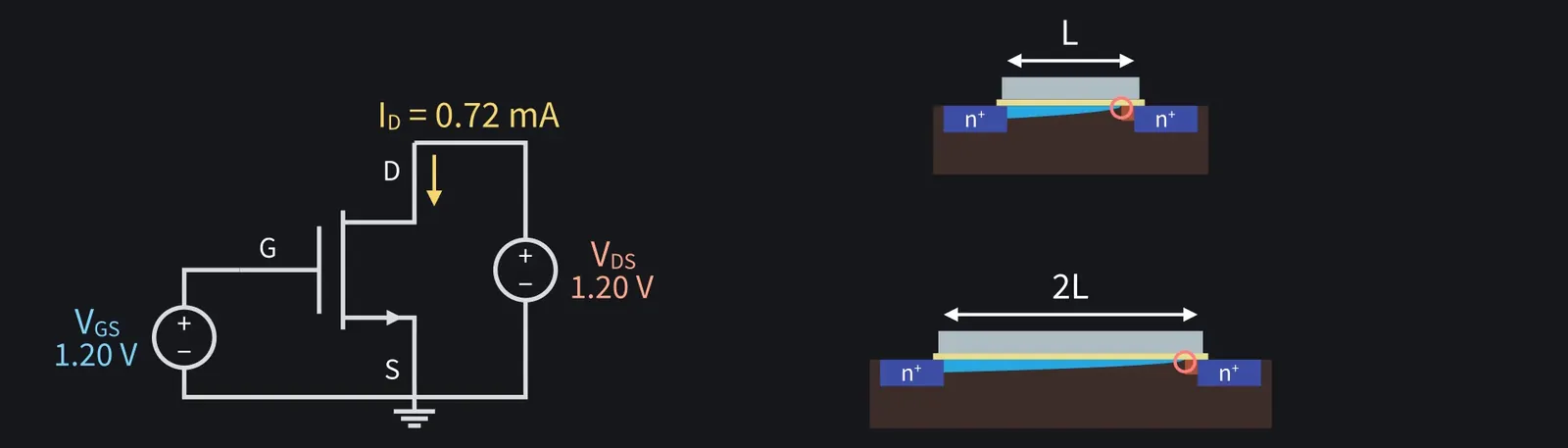
One way is to make the channel length L longer.

Illustration: One way is to make the channel length L longer.
Figure 21

Shikoku Metan

The same pinch-off shift is a smaller fraction of a longer channel.

Shikoku Metan: So increasing L tends to reduce λ.

Illustration: So increasing L tends to reduce λ.
Figure 22

Shikoku Metan

Very short channels in advanced processes tend to have larger λ and smaller ro.

8Why ro matters: intrinsic gain gm·ro

ZundamonQuestion

Why is small ro a problem?
Shikoku Metan

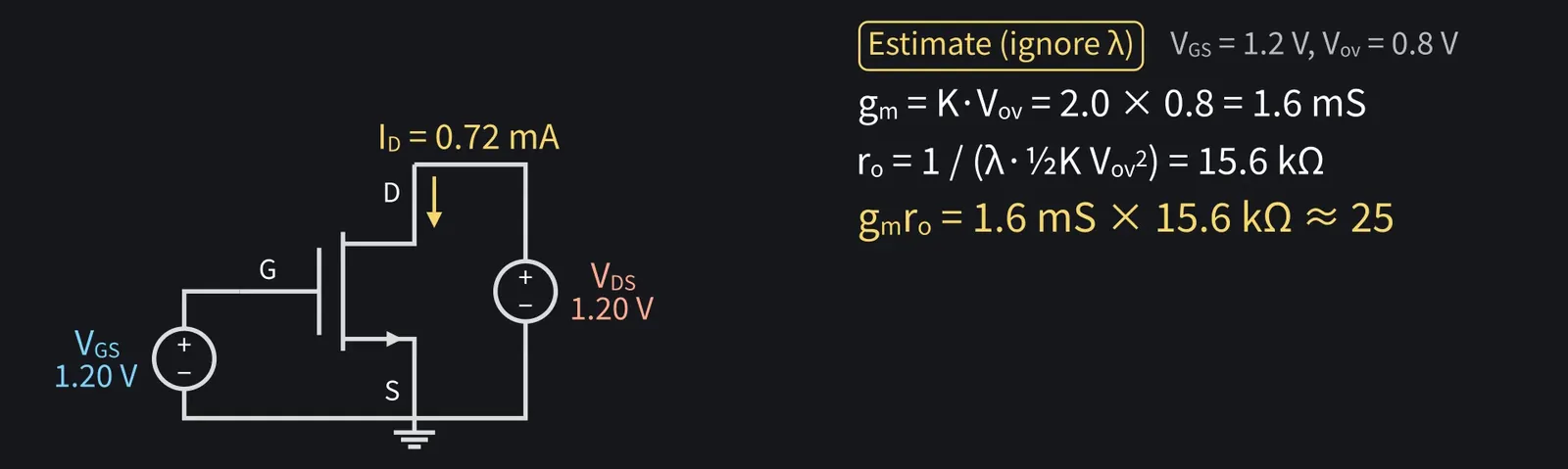
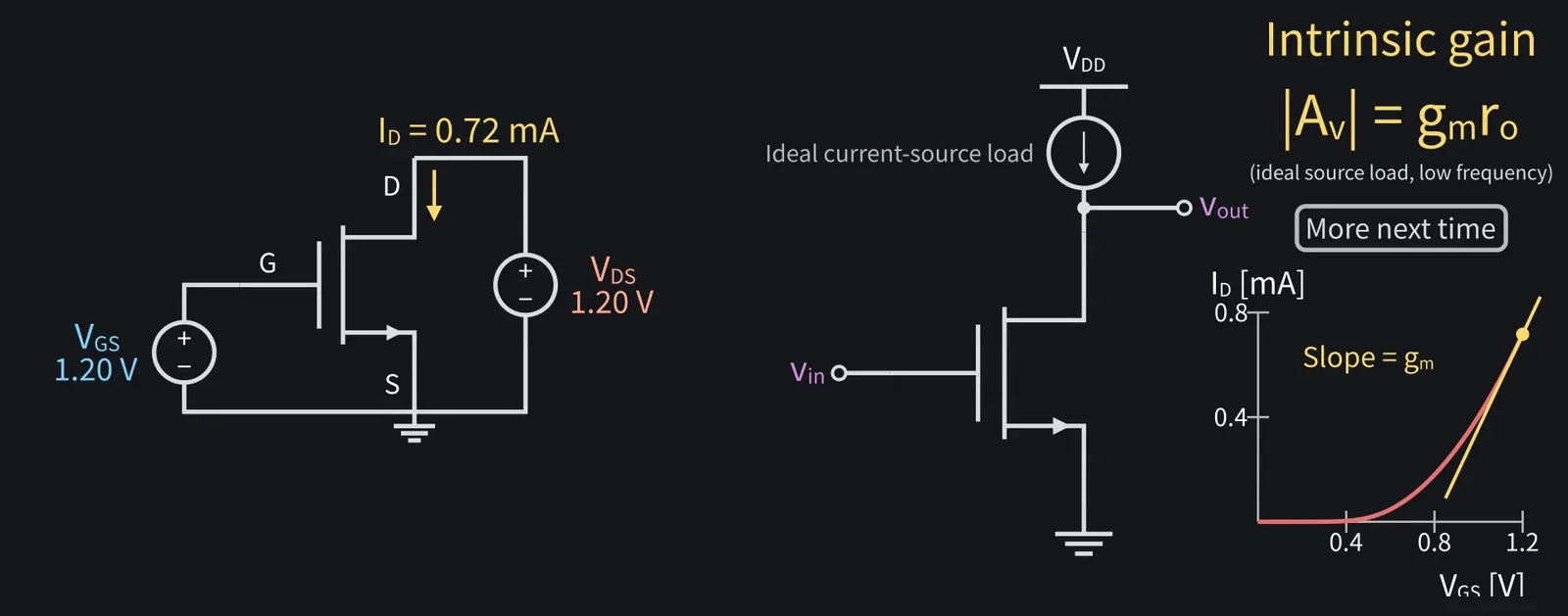
Because a single-transistor amplifier with an ideal current-source load has a voltage gain of magnitude gm·ro.

Shikoku Metan: That's called the intrinsic gain. gm, the transconductance, measures how much ID changes with VGS; more on it next time.

Illustration: That's called the intrinsic gain. gm, the transconductance, measures how much ID changes with VGS; more on it next time.
Figure 23

Shikoku Metan

Ignoring λ, gm = K·Vov=1.6 mS. Times about 16 kΩ gives roughly 25.

Illustration: Ignoring λ, gm = K·Vov = 1.6 mS. Times about 16 kΩ gives roughly 25.
Figure 24

Shikoku Metan

Including λ gives gm≈1.8 mS and an intrinsic gain of about 28.

Zundamon

So small ro means small gm·ro and less amplification.

Shikoku Metan

Yes. Short-channel devices often need circuit techniques to recover gain.

9Body effect

Zundamon

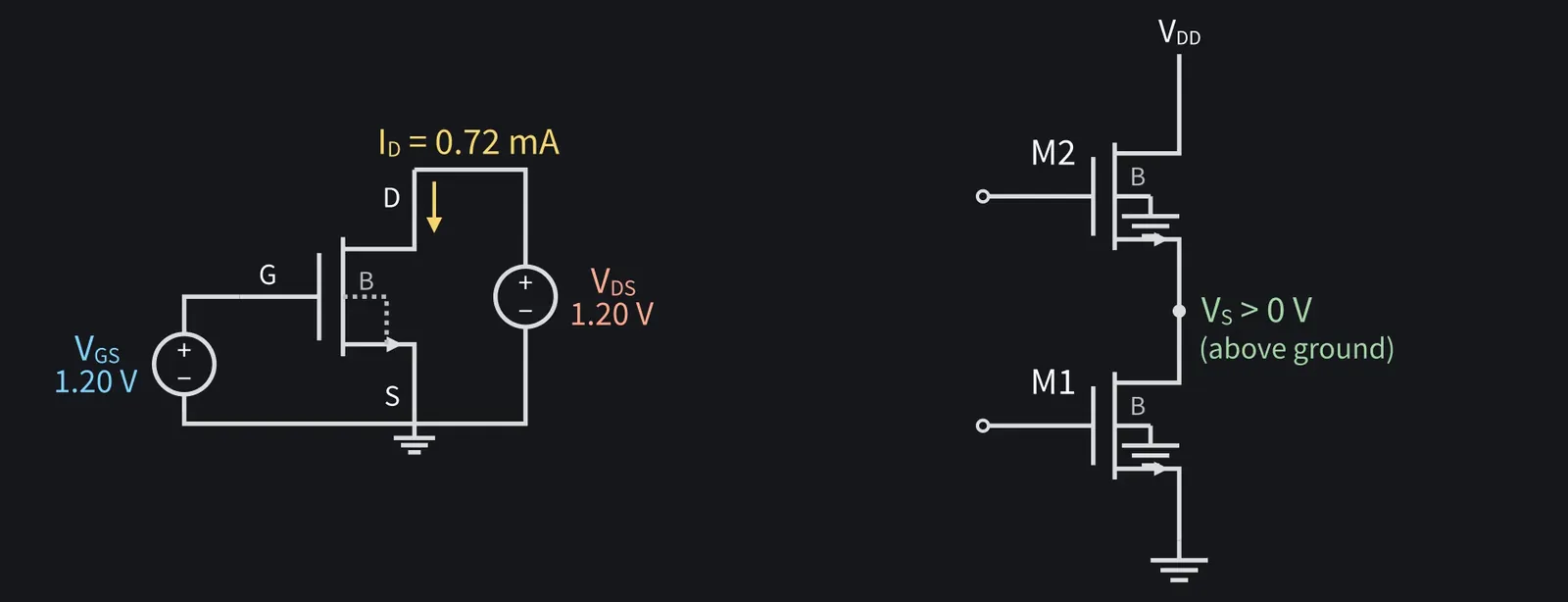
Last time, we assumed the body was connected to the source.
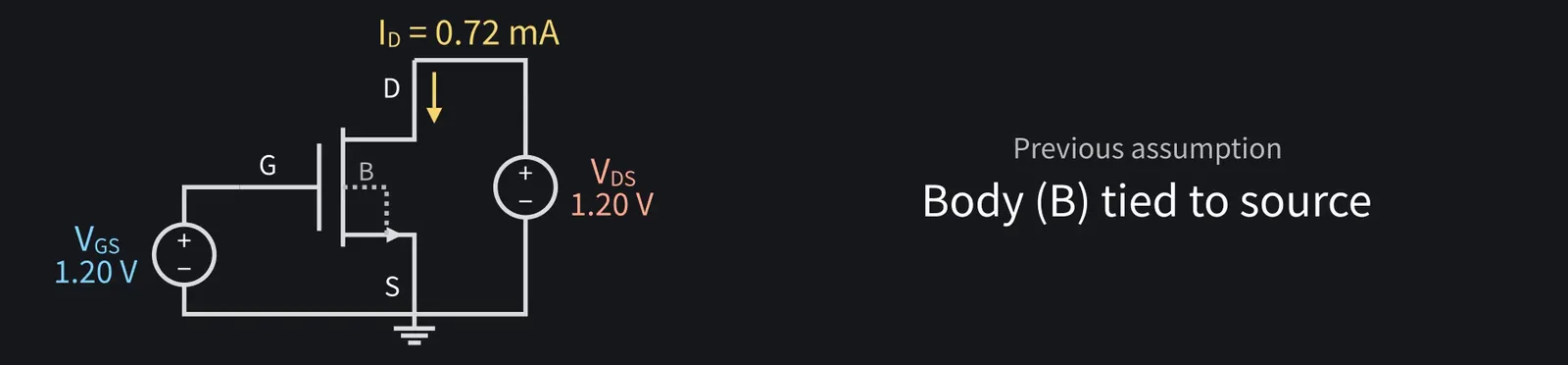
Illustration: Last time, we assumed the body was connected to the source.
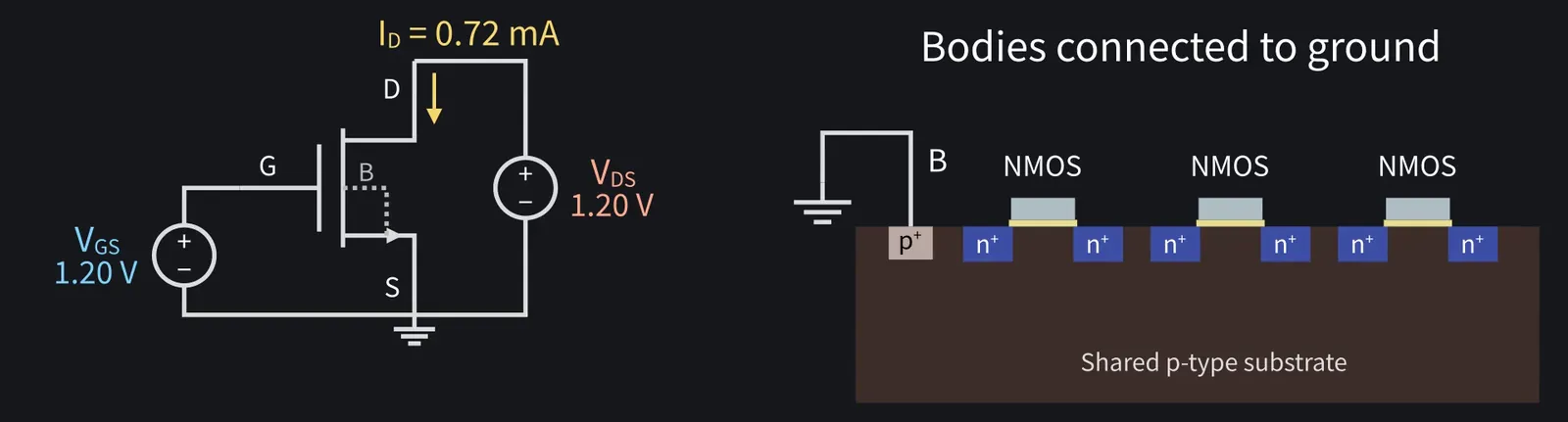
Figure 25

Shikoku Metan

Yes. But in an IC, the NMOS bodies all share the p-substrate, which is tied to ground.

Illustration: Yes. But in an IC, the NMOS bodies all share the p-substrate, which is tied to ground.
Figure 26

Shikoku Metan

Stack two transistors, and the upper one's source sits above ground, so it's no longer at the body potential.

Illustration: Stack two transistors, and the upper one's source sits above ground, so it's no longer at the body potential.
Figure 27

Shikoku Metan

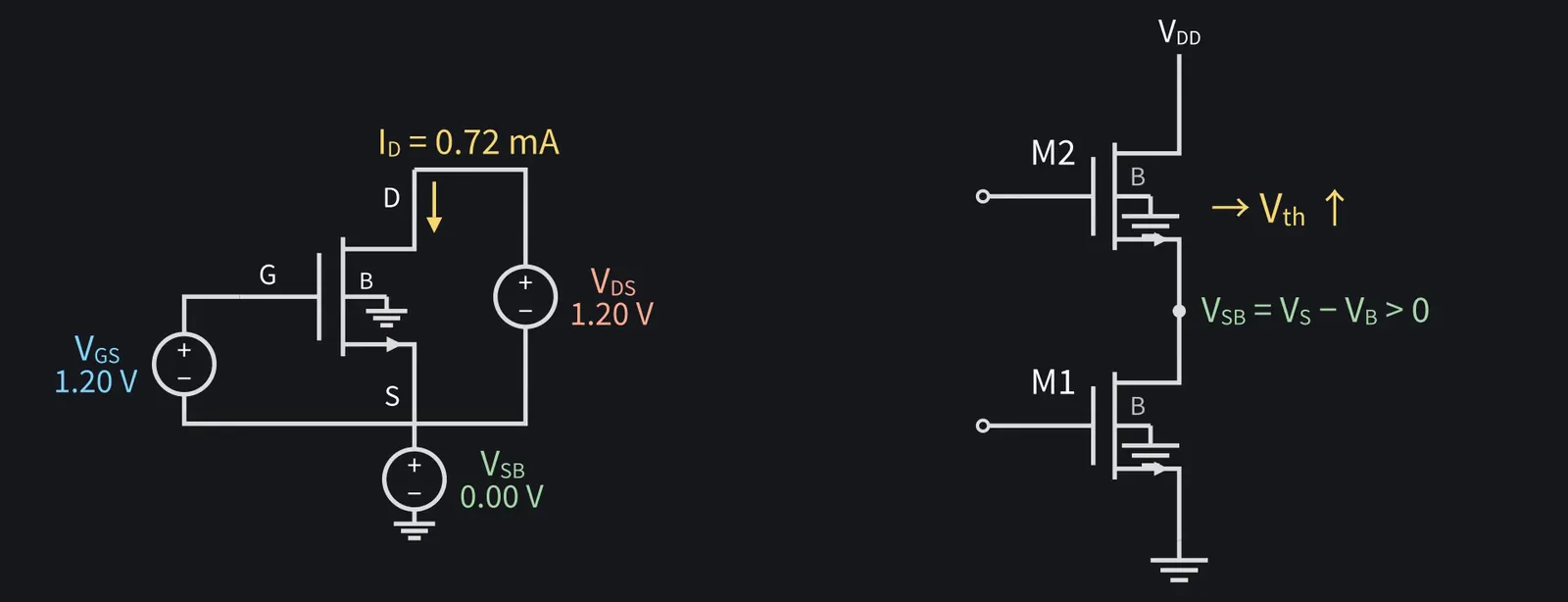
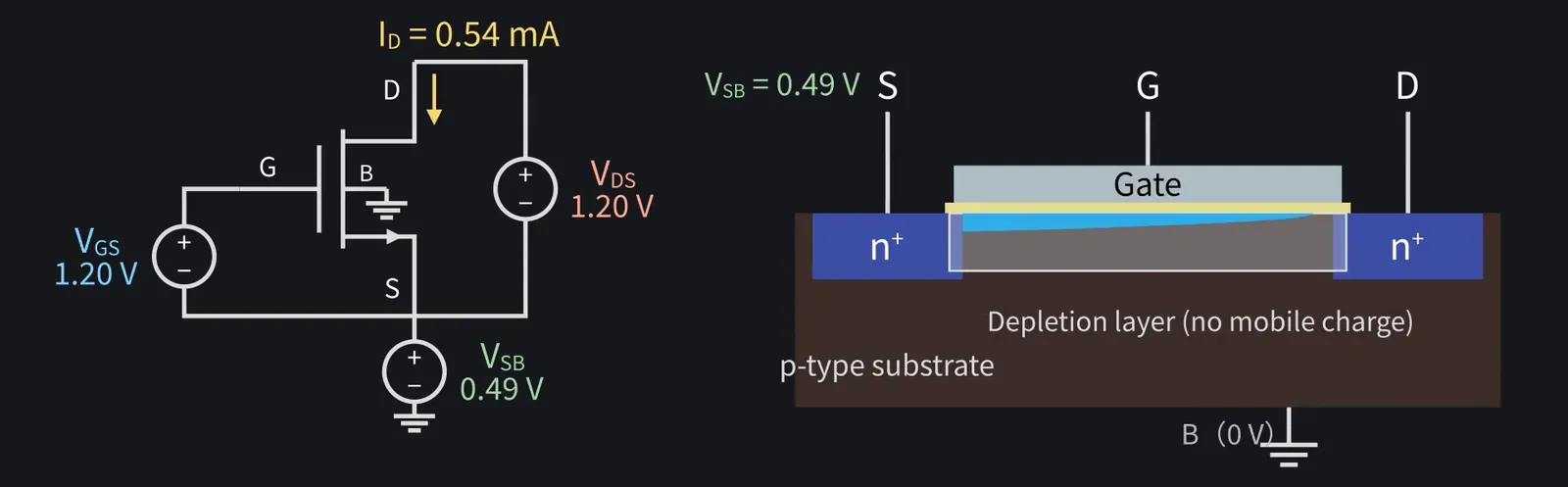
VSB is source voltage minus body voltage. Positive VSB raises Vth.

Illustration: VSB is source voltage minus body voltage. Positive VSB raises Vth.
Figure 28

ZundamonQuestion

Why does Vth change if VGS stays the same?
Shikoku Metan

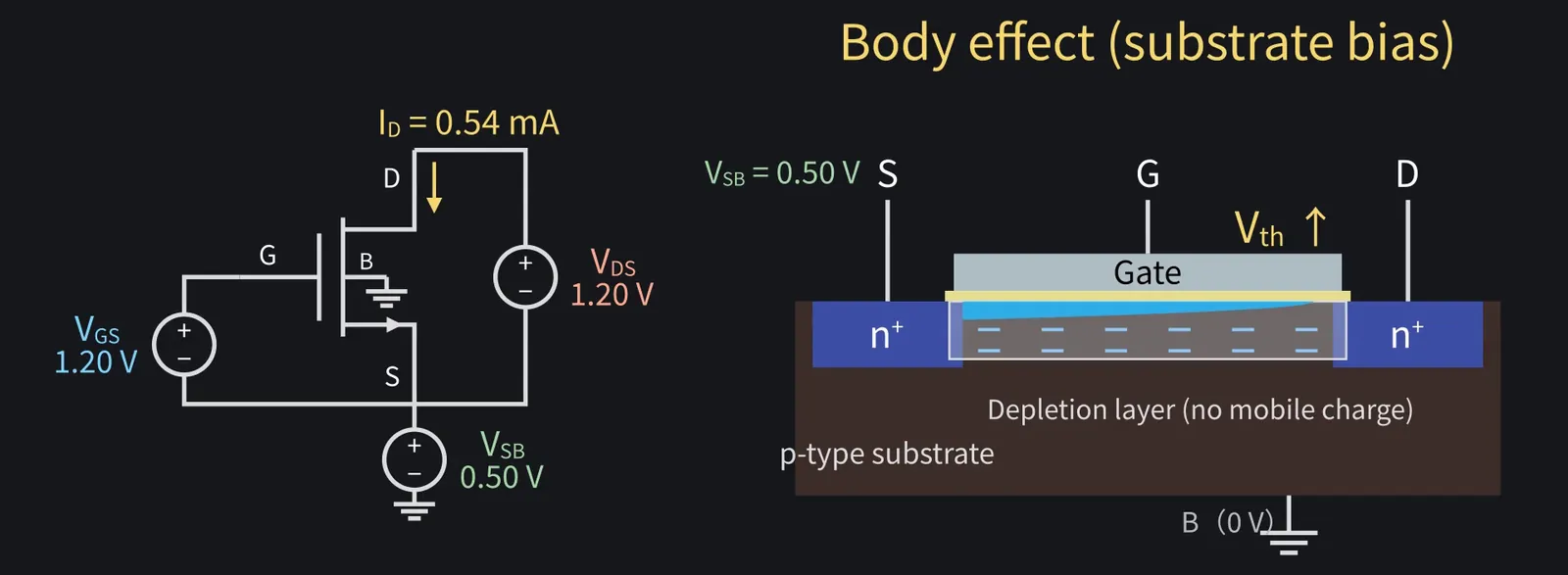
Positive VSB widens the depletion layer beneath the channel.

Illustration: Positive VSB widens the depletion layer beneath the channel.
Figure 29

Shikoku Metan

More fixed ion charge is left in the depletion layer, so a larger gate voltage is needed to form the channel.

Shikoku Metan: This is called the body effect, or substrate-bias effect.

Illustration: This is called the body effect, or substrate-bias effect.
Figure 30

Shikoku Metan

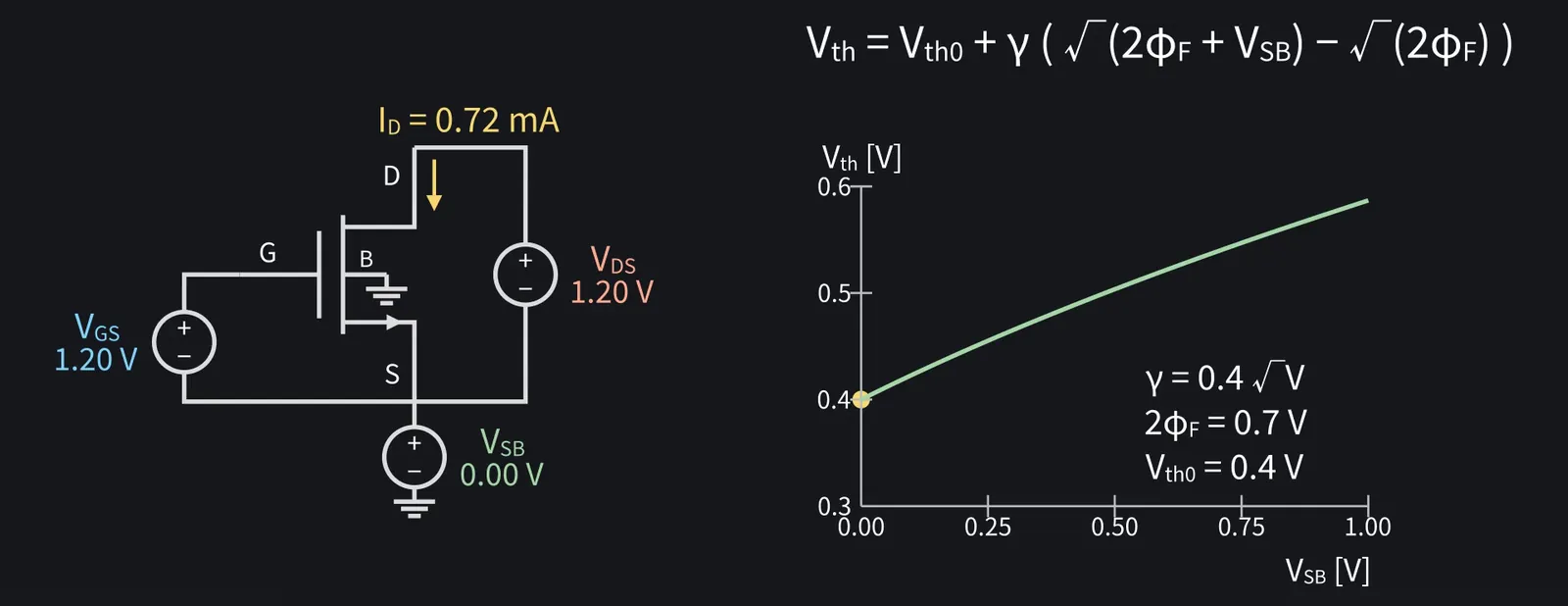
Here's the formula. Vth rises with VSB, but the increase gradually slows.

Shikoku Metan: γ and 2φF are process constants: here γ = 0.4 √V and 2φF=0.7 V. Vth0 is Vth at VSB=0.

Illustration: γ and 2φF are process constants: here γ = 0.4 √V and 2φF = 0.7 V. Vth0 is Vth at VSB = 0.
Figure 31

Shikoku Metan

At VSB=0.5 V, Vth rises from 0.40 V to about 0.50 V.

ZundamonQuestion

So the current falls even with the same VGS?
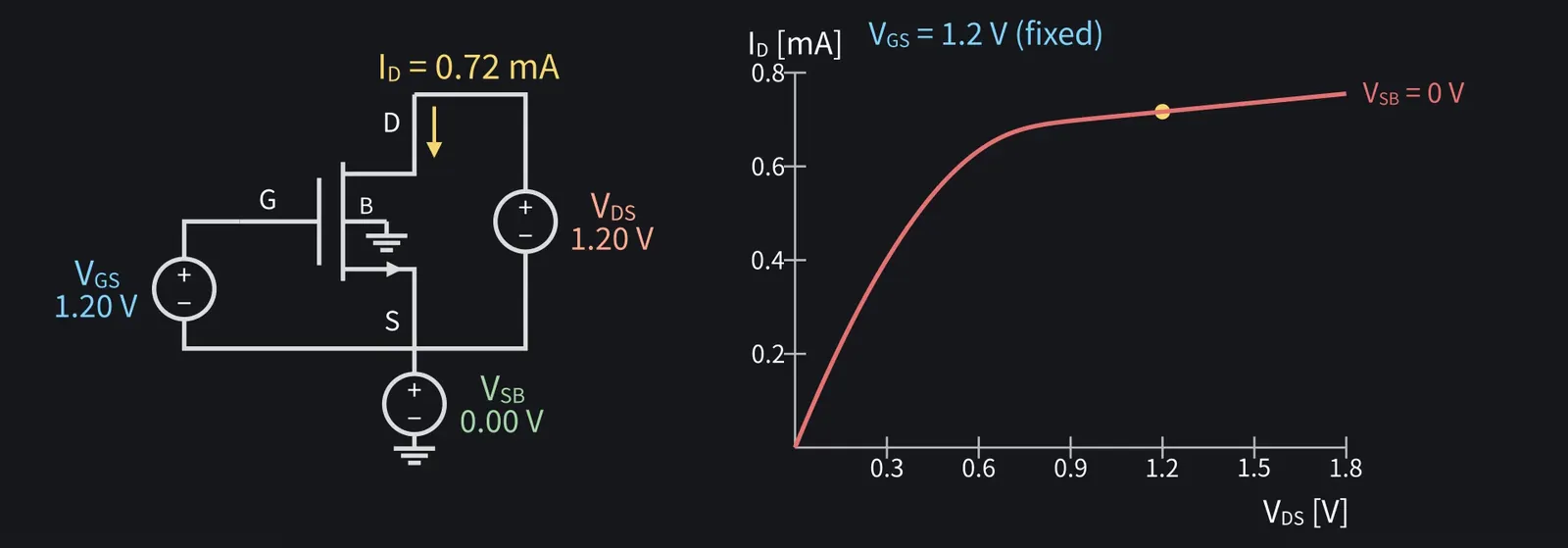
Illustration: So the current falls even with the same VGS?
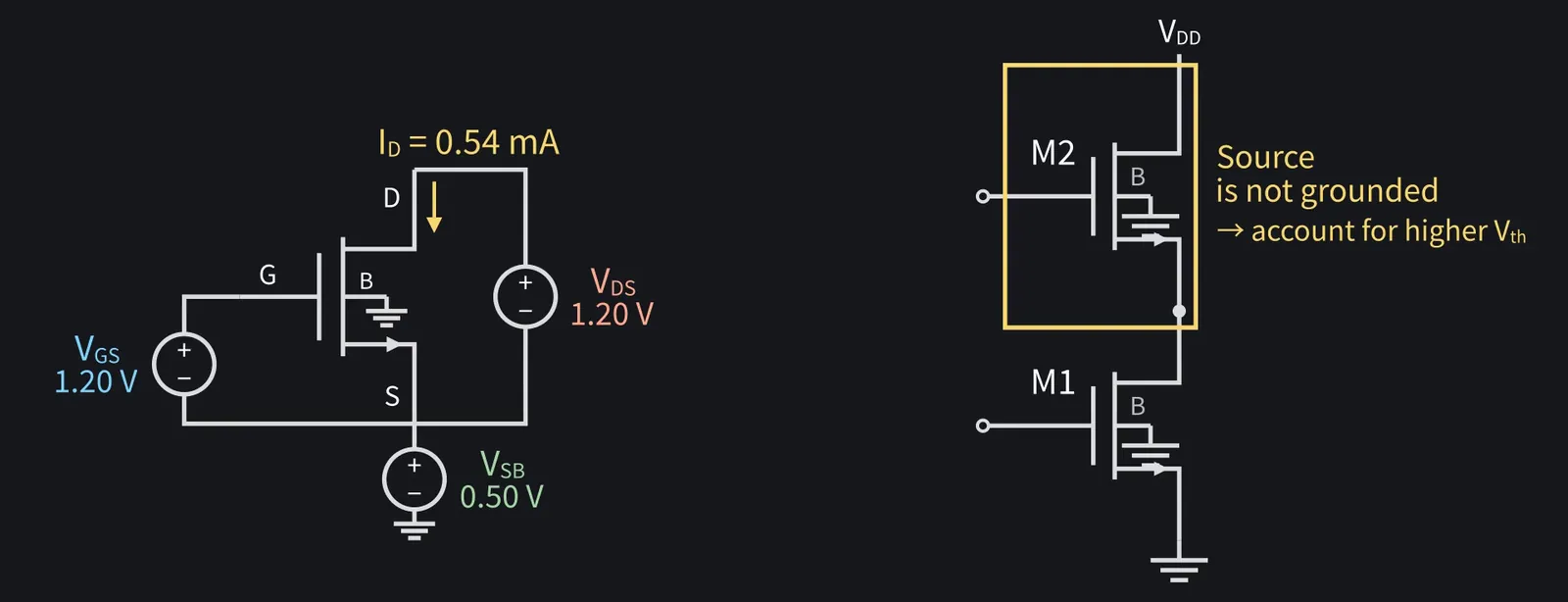
Figure 32

Shikoku Metan

Yes. Holding VGS and VDS at 1.2 V, ID falls from 0.72 mA to about 0.54 mA.

Shikoku Metan: Include this effect when designing circuits whose sources aren't grounded.

Illustration: Include this effect when designing circuits whose sources aren't grounded.
Figure 33

10Summary

Shikoku Metan

Channel-length modulation moves pinch-off, making ID increase with VDS.

Shikoku Metan: ro is the inverse slope. Larger ro means a better source and higher intrinsic gain.

Illustration: ro is the inverse slope. Larger ro means a better source and higher intrinsic gain.
Figure 34

Zundamon

And positive VSB raises Vth and reduces current!

Zundamon: That slope wasn't a measurement error! I'll calculate ro and fix my report!

Shikoku Metan

Next time: gm, the small-signal model, and common-source amplifier gain.

Illustration: Next time: gm, the small-signal model, and common-source amplifier gain.
Figure 35

Zundamon

Thanks for reading, nanoda!