Keio University · Computing and Sensing Group
LiDAR spoofing: raw captures of injection and removal attacks
Packet captures (.pcap) from the physical experiments behind our LiDAR spoofing papers, each paired with a video. Every capture comes with a bird’s-eye rendering made from the pcap itself; where the original VeloView screen recording or a camera view exists, it is shown alongside.
Benign capture
Attack capture
Camera view of the scene
CPI = Chosen Pattern Injection · PRA = Physical Removal Attack (synchronized) · HFR = High-Frequency Removal · A-HFR = adaptive HFR
Using the captures
- Each download is a zip holding one unmodified pcap, exactly as recorded (VeloView, PandarView or Wireshark) on UDP port 2368. The SHA-256 shown is that of the pcap inside.
- Open Velodyne captures in VeloView (or
velodyne_decoder, ROSvelodyne_pointcloud) and Hesai captures in PandarView or the Hesai LiDAR SDK. AT128 needs its angle-correction file, which is attached to the NDSS 2025 release. The LiDAR model and return mode below are read from the packets themselves. - Bird’s-eye renderings are top-down views, 0.1 s per frame (one 600 rpm revolution), coloured by height. In dual-return captures only the first return of each pair is drawn. AT128 renderings ignore its fine per-channel angle offsets (under about 0.5°).
- Recorded videos are VeloView screen recordings made during the experiments; some were matched to their capture by timestamp.
- “Removal check” (Hesai captures): share of 0.1 s frames with an azimuth gap of at least 8° where the scene normally returns points, and the longest run of such frames. Benign captures score 0 %. Attack runs in which the attack did not take effect are not published.
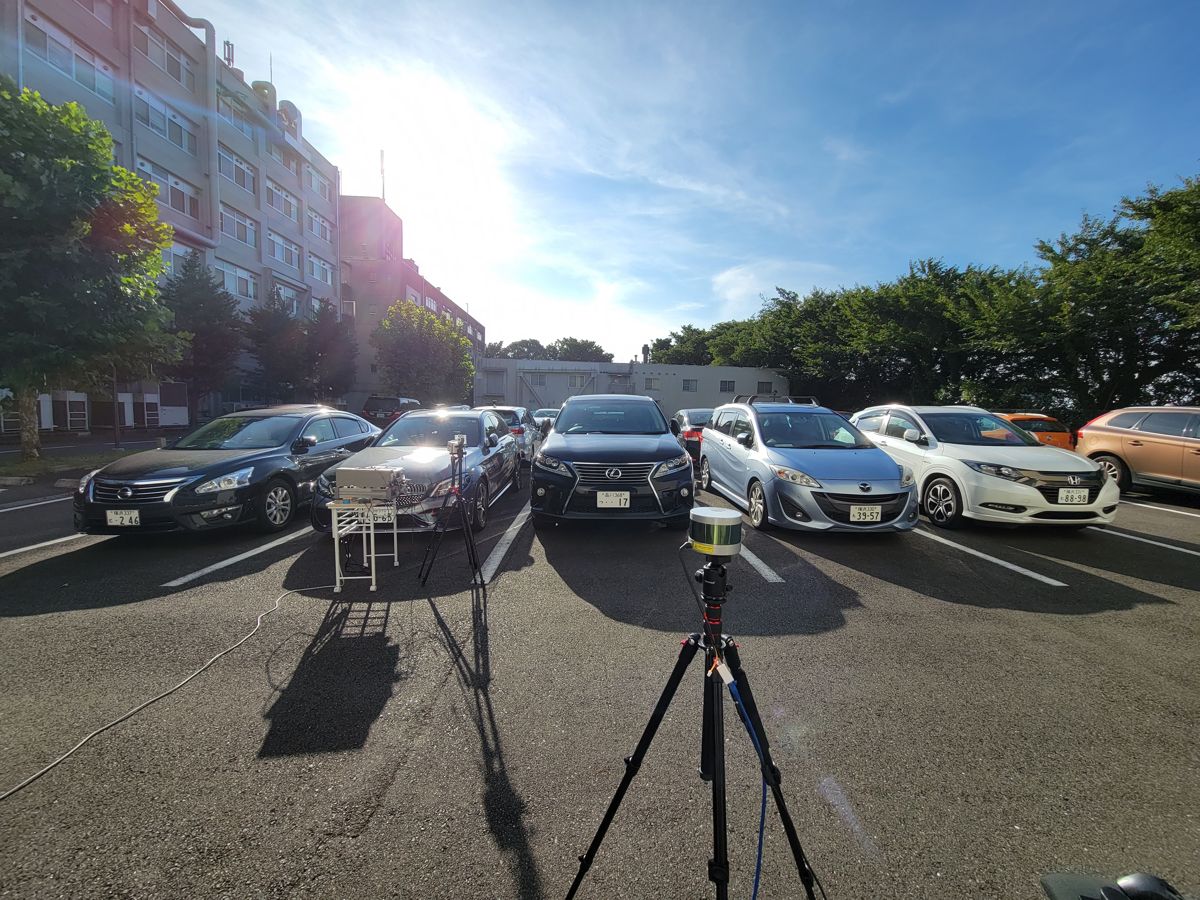
Experimental setup (NDSS 2024)